He refused to sign away his constitutional rights. Then he refused to participate in modern life at all.
By Oskar Rausch
November 28, 2025
The houseboat bobs gently in Lake Huron, anchored about 200 yards off a small, nameless island in Michigan’s Thumb region. There is no dock. Visitors must hire a boat from the mainland, navigate past a half-submerged buoy, and announce themselves by shouting. A German Shepherd named Kai will bark—not aggressively, just to establish that someone is paying attention.
Dr. TooToo Medvalli, MD, will emerge from the cabin wearing a flannel shirt with a laminated pocket Constitution visible in the breast pocket. He is 61 years old, board-certified in gastroenterology, and has not practiced medicine in 18 years. He has not had a cell phone in 18 years. He has not used the internet, held a credit card, or maintained a bank account in 18 years.
He has, however, preserved every single one of his Seventh Amendment rights.
“I am aware,” he tells me, settling into a camp chair on the deck, “that this makes me sound insane.”
The numbers are not in dispute. Employees who must resolve workplace disputes through mandatory arbitration win only 21.4 percent of their cases, compared with 36.4 percent in federal court. When they do prevail, their median award of $36,500 represents barely one-fifth of the $176,426 median in court. Perhaps most troubling, researchers estimate that 98 percent of potential employment claims simply vanish—never filed because the system is designed to make pursuing them economically irrational.
These statistics come from Professor Alexander J.S. Colvin of Cornell University, whose research on employment arbitration is the most comprehensive in the field. Professor Cynthia Estlund of NYU Law School has documented what she calls “the black hole of mandatory arbitration”—the phenomenon whereby more than 60 million American workers are subject to mandatory arbitration, yet only about 2,500 employment arbitration cases are filed each year. That’s one claim for every 10,400 covered workers.
The legal scholars have a term for agreements that consumers and employees must accept without negotiation: contracts of adhesion. Sign or don’t get the job. Sign or don’t open the bank account. Sign or don’t use the cell phone.
TooToo Medvalli chose “don’t.”
To understand how a gastroenterologist ended up living on a houseboat in Lake Huron, communicating exclusively through the United States Postal Service, you have to understand that TooToo Medvalli has never done anything halfway.
He was born in 1986 in Hamtramck, Michigan, to Hungarian immigrant parents who emphasized education with the intensity common to families who had sacrificed everything to provide it. He graduated from the University of Michigan, attended the University of Michigan Medical School, completed his internal medicine residency at UCSF, and finished a gastroenterology fellowship at Stanford. By 2018, at age 32, he was a board-certified gastroenterologist with offers from three major health systems.
He was also, by his own description, “constitutionally incapable of not reading things.”
“My colleagues would get these contracts—60, 70 pages—and they’d flip to the salary section, maybe glance at the benefits, and sign,” Medvalli says. “I read every word. Every clause. Every definition in the appendix.”
It was in one of these appendices that he first encountered a mandatory arbitration clause.
“I remember the exact moment,” he says. “Page 47. ‘Any dispute arising out of or relating to this Agreement shall be resolved exclusively through binding arbitration.’ I didn’t even know what that meant. So I looked it up.”
What he found changed the trajectory of his life.
The Federal Arbitration Act of 1925 was drafted by Julius Henry Cohen, a Progressive-era lawyer, and championed by the New York Chamber of Commerce for a specific, limited purpose: enabling merchants of relatively equal bargaining power to resolve disputes efficiently outside congested courts. The drafters repeatedly assured legislators that the Act would not apply to employment contracts or adhesion contracts. Section 1 explicitly exempts “contracts of employment of seamen, railroad employees, or any other class of workers engaged in foreign or interstate commerce.”
The Supreme Court has spent the past four decades systematically transforming this narrow procedural statute into something its drafters would not recognize.
Southland Corp. v. Keating (1984) held that the FAA applies in state courts and preempts conflicting state laws—despite legislative history clearly indicating Congress viewed the FAA as purely procedural. Circuit City Stores v. Adams (2001) narrowed the employment exemption to cover only transportation workers, extending FAA coverage to virtually all employment contracts. AT&T Mobility v. Concepcion (2011) held that the FAA preempts state unconscionability doctrines that would invalidate class action waivers. Epic Systems Corp. v. Lewis (2018) ruled that employers can use individual arbitration agreements to prevent collective action even for wage and hour claims.
Justice Ruth Bader Ginsburg read her dissent in Epic Systems from the bench—a rare act of judicial protest. She called for congressional correction of the Court’s “elevation of the FAA over workers’ rights.”
Congress has not corrected it.
“I went to HR,” Medvalli recalls, “and I said, ‘I can’t sign this.’ They looked at me like I’d grown a second head.”
He explained his concerns: the elimination of jury trial rights, the restriction of discovery, the repeat-player advantage that research showed systematically favored employers, the class action waiver that would prevent workers from banding together to challenge systematic violations.
The HR representative listened politely. Then she said, “It’s standard. Everyone signs it.”
“That’s not a legal argument,” Medvalli replied. “That’s a description of capitulation.”
He was not hired.
Over the next six months, Medvalli applied to 47 different healthcare organizations. Every single one required mandatory arbitration as a condition of employment. Every single one told him it was “standard.”
“I started keeping a tally on my pocket Constitution,” he says, pulling out the document—laminated now, worn at the edges. Small hash marks cover the inside back cover. “Forty-seven rejections. All for the same reason. I wasn’t refusing to work. I wasn’t asking for more money. I was just asking to retain access to the legal system that the Constitution guarantees.”
The question everyone asks—the question I asked, standing on his houseboat deck while Kai investigated my backpack with alarming intensity—is: Why not just sign?
Medvalli has heard this question hundreds of times. He has a speech prepared.
“In 1992, the year after the Supreme Court’s Gilmer decision permitted arbitration of federal employment discrimination claims, approximately 2 percent of American workers were subject to mandatory arbitration,” he says, rattling off statistics with the fluency of a man who has spent 18 years alone with legal journals. “By 2017, that figure had reached 56.2 percent—more than 60 million workers. The Economic Policy Institute projected it would reach 80 percent by 2024. Eighty percent of American workers, required to surrender their constitutional rights as a condition of employment.”
He pauses.
“At what point does a right that can be forced-waived as a condition of basic economic participation stop being a right at all?”
The dog deserves his own explanation. Medvalli acquired Kai in 2026, shortly after losing his house to foreclosure. (The mortgage company’s arbitration clause had prevented him from disputing the foreclosure in court—a fact Medvalli describes as “darkly ironic.”) Kai is now 17 years old, ancient for a German Shepherd. In his younger years, he expressed his considerable psychological complexity through the systematic destruction of fabric, furniture, and infrastructure.
“He once humped a buoy so aggressively it sank,” Medvalli says, with something approaching affection. “I had to pay to have it replaced. In cash, obviously. I don’t have a bank account.”
The cascade of withdrawals happened gradually, then all at once.
First the employment contracts. Then the cell phone, after Medvalli actually read his Verizon service agreement and discovered that he’d theoretically agreed to waive his right to sue, his right to participate in class actions, and his right to a jury trial.
“I threw it in Lake Huron,” he says. “Kai looked very confused. He expected to retrieve it.”
Then the internet (arbitration clause). The credit cards (arbitration clauses). The streaming services (arbitration clauses). The bank account (arbitration clause).
“Did you know that credit card issuers representing 53 percent of all credit card debt impose arbitration?” Medvalli asks. “Affecting over 80 million consumers? The Consumer Financial Protection Bureau documented this in 2015. Ten years ago. Nothing has changed.”
He bought the houseboat in 2027, anchoring it off a small island because even the mainland marina operators had arbitration clauses in their slip rental agreements. He grows vegetables, collects rainwater, catches fish. He communicates through the U.S. Postal Service, which he notes with satisfaction has no arbitration clause.
His sister, Margaret, visits once a month to bring supplies. She has spent 18 years trying to convince him to rejoin society.
“The Founders would be proud,” Medvalli tells her.
“The Founders used corn cobs,” she replies.
He takes the toilet paper.
Word of Medvalli’s stand has spread slowly through legal academic circles. Law students write papers about him. Constitutional scholars cite him in footnotes. A documentary crew visited in 2031—arriving in an arbitration-clause-encumbered rental boat—and produced a film that premiered at Sundance to modest acclaim.
Medvalli didn’t see it. He couldn’t sign the streaming service’s terms of service.
“It made you look only moderately insane,” Margaret reported.
The film sparked a brief national conversation about forced arbitration. Op-eds were written. Senators gave speeches. The FAIR Act—the Forced Arbitration Injustice Repeal Act, which would invalidate pre-dispute arbitration agreements for employment, consumer, antitrust, and civil rights disputes—was reintroduced in Congress. A hashtag trended for nearly six hours.
Then everyone went back to clicking “I Agree” without reading.
One letter stood out from the thousands Medvalli received after the documentary. It came from Gretchen Carlson, the former Fox News anchor whose lawsuit against Roger Ailes had been complicated by her employment contract’s arbitration clause. Carlson had found a legal strategy to circumvent the clause—suing Ailes personally under New York City law—and her $20 million settlement had helped catalyze the #MeToo movement. In 2022, she’d advocated successfully for the Ending Forced Arbitration of Sexual Assault and Sexual Harassment Act, which President Biden signed into law.
“Dear Dr. Medvalli,” the letter read:
I understand your fight. When I discovered what my arbitration clause meant—that I would be forced into the secret chamber of arbitration, and nobody would ever hear from me again—it was one of the darkest days of my life.
But I chose to find a way around it, to fight within the system, to change what I could. The 2022 law that lets survivors of sexual assault and harassment choose court over arbitration—it happened because of that fight.
You’ve chosen to step outside the system entirely. I’m not sure either of us is right. But I’m not sure either of us is wrong, either.
The law I helped pass was called “the biggest labor law change in 100 years.” But it only covers sexual assault and harassment claims. Wage theft claims? Discrimination claims? Safety violations? Still arbitrated. Still disappeared.
Maybe we need both approaches—people like me fighting from inside, and people like you refusing to participate at all.
Medvalli has the letter pinned to his cabin wall, next to a handwritten sign that reads:
THEORETICAL RIGHTS: 100%
PRACTICAL PARTICIPATION IN MODERN SOCIETY: 0%
REGRETS: COMPLICATED
“I am not a model to emulate,” Medvalli says, as the sun begins to set over Lake Huron. Another cruise ship—one of the small Great Lakes tour vessels—passes in the distance. “I am a cautionary tale.”
He is quiet for a moment.
“But maybe every person who clicks ‘I Agree’ without reading should have to look at me first and ask themselves: Is this the only alternative? Is the choice really between surrendering your constitutional rights and becoming this?”
He gestures at the houseboat, the island, the dog now attempting to mount my backpack.
“If the answer is yes—if the system has been designed so that the only way to preserve your rights is to withdraw from society entirely—then at least people should know that’s the choice they’re making. At least it shouldn’t be done in ignorance, buried in fine print, invisible and unexamined.”
Kai successfully mounts the backpack. Medvalli doesn’t apologize.
“He does that,” he says.
Federal Judge William G. Young once wrote that the rise of forced arbitration represents “among the most profound shifts in our legal history. Ominously, business has a good chance of opting out of the legal system altogether and misbehaving without reproach.”
Proponents argue that arbitration is faster and cheaper than litigation. The Chamber of Commerce claims consumers win more often in arbitration and receive comparable awards. But these arguments ignore what researchers call “the denominator problem”: they examine only the tiny fraction of claims that make it to arbitration, not the 98 percent that disappear. They ignore the repeat-player advantage that systematically favors corporations. They ignore that a system designed to be fast and cheap is worthless if it deters virtually all claims from being filed.
The Seventh Amendment guarantees the right to a jury trial in civil cases. The Founders understood that this right served as a critical check on concentrated power. When corporations can compel their employees and customers to surrender this right as a condition of employment or commerce, they have effectively nullified a constitutional protection for the vast majority of Americans.
TooToo Medvalli knows all of this. He has had 18 years to read about it, think about it, write letters to congressmen about it.
None of it has changed anything.
As I motor back to the mainland, I pass the spot where the buoy used to be—the one Kai allegedly sank. The sun is setting, painting Lake Huron in shades of orange and pink. It is, objectively, beautiful.
My phone buzzes. A notification from my bank: updated terms of service. Would I like to review them?
I think about Medvalli, alone on his houseboat, communicating through letters, preserving his theoretical rights while the world clicks “I Agree” around him.
I think about the 60 million workers bound by arbitration clauses. The 300 million telecom subscribers. The 80 million credit card holders. The 98 percent of claims that simply vanish.
I think about whether rights that can be forced-waived are really rights at all.
Then I click “I Agree” without reading.
I have a mortgage to pay.
Oskar Rausch is a researcher at the Make America Constitutional Again Institute (MACAI) in San Juan, Puerto Rico. He can be contacted at oskar.rausch@proton.me
Editor’s Note
The statistics cited in this article are drawn from peer-reviewed research, including:
Alexander J.S. Colvin, “An Empirical Study of Employment Arbitration,” Journal of Empirical Legal Studies (2011)
Cynthia Estlund, “The Black Hole of Mandatory Arbitration,” North Carolina Law Review (2018)
Katherine V.W. Stone & Alexander J.S. Colvin, “The Arbitration Epidemic,” Economic Policy Institute (2015)
Consumer Financial Protection Bureau, “Arbitration Study: Report to Congress” (2015)
Dr. TooToo Medvalli is a fictional character who first appeared in “Cruise Ship Doctor” (2025). This article is a work of satirical fiction. All constitutional principles cited are real. All absurdity is intentional.
“The boycott had been comprehensive, almost impressive in its coordination.”
DISCLAIMER
This is a work of satire inspired by real events in American healthcare employment. All characters, names, and identifying details have been changed. Any resemblance to actual persons, living or dead, or actual organizations is purely coincidental. The legal cases and public records cited (Cascade Health Solutions v. PeaceHealth, wage theft settlements, etc.) are matters of public record and documented fact. The author’s experiences with healthcare employment negotiations are real. The names are not.
PART I: THE VIEW FROM THE CRUISE SHIP
Chapter 1: Welcome to Gravina Island
The thing about watching your professional life collapse from a houseboat anchored off Gravina Island is that you have plenty of time to consider the absurdity of it all. Which is exactly what I was doing at 6:47 AM on a Tuesday morning when the Norwegian Joy glided past, its passengers waving cheerfully at the picturesque Alaskan landscape while I stood on my floating prison in my bathrobe, holding a cup of instant coffee and contemplating the series of decisions that had led me here.
Dr. TooToo Medvalli, MD. Board-certified gastroenterologist. Three months into my “opportunity” with PeaceHealth Ketchikan Medical Center. Living on a houseboat because even the marina operators had refused my business.
The boycott had been comprehensive, almost impressive in its coordination. No landlord would rent to me. Grocery stores turned me away at the door—politely, always politely, with that particularly Alaskan brand of courtesy that made rejection feel like a favor. Even the dispensaries claimed to be out of stock. The ferry operators, those stoic civil servants, found creative reasons why I couldn’t board. “System’s down.” “Weight limits.” “Weather advisory.”
It was remarkable, really, how a community of 8,000 souls could mobilize against one physician who’d had the audacity to—
Well. We’ll get to that part.
I waved back at the cruise ship passengers. Force of habit. They couldn’t see me anyway, but I’d developed this peculiar routine over the past three months. Wave at the tourists. Remind yourself you’re still visible. Still human. Still technically a physician, though increasingly unclear what that actually meant in Ketchikan.
My phone buzzed. An email from Mupeet, the PeaceHealth recruiter who’d promised me this would be a “seamless transition” to “Alaska’s premier healthcare destination.”
I didn’t need to open it to know what it said. The same thing every email from PeaceHealth said, in increasingly creative variations: We have a standard contract for all 1,300 physicians.
As if repeating a number made something true. As if 1,299 other physicians signing a terrible contract somehow obligated me to do the same. It was the logical equivalent of saying “well, everyone else jumped off the cliff, so you should too,” except dressed up in corporate HR language and delivered with the cheerful insistence of someone who’d been trained to never acknowledge that they were, in fact, asking you to jump off a cliff.
But I’m getting ahead of myself. This story doesn’t start on a houseboat off Gravina Island. It starts the way all medical disasters start: with hope, enthusiasm, and a completely unrealistic expectation that institutions designed to extract value from physicians might actually treat physicians like human beings.
Let me back up.
Chapter 2: How I Learned to Stop Worrying and Love the Credentialing
JUNE 2025
“Dr. Medvalli, we’re so excited to have you join the PeaceHealth family!”
Mupeet’s voice on the phone had that particular pitch of enthusiasm that immediately made me suspicious. I’d been a physician long enough to know that when healthcare administrators used words like “family” and “exciting opportunity,” what they actually meant was “we’re about to make your life significantly more complicated and then act surprised when you’re not grateful.”
But I was optimistic. Foolishly, embarrassingly optimistic. Ketchikan needed physicians. I was a physician. Simple supply and demand, right? Economics 101. What could possibly go wrong?
“I just need you to complete your credentialing application through VerityStream,” Mupeet continued. “It’s very straightforward. Most physicians finish it in one sitting.”
Famous last words.
VerityStream, for the uninitiated, is what happens when someone decides that the already byzantine process of medical credentialing could be made worse through digitization. It’s a platform that manages to combine the user-unfriendliness of a 1990s website with the reliability of a dial-up modem, all wrapped in the kind of interface design that makes you wonder about healthcare systems’ choice of software.
I logged in. Or tried to. The VPN I use for security—standard practice for anyone who doesn’t want to broadcast their medical license information across open WiFi networks—was blocked. No error message. No explanation. Just… blocked.
I tried a different U.S.-based VPN server. Blocked.
I tried without a VPN. The page loaded, then immediately crashed.
I tried a different browser. Same result.
I tried my phone. The login page appeared, but when I entered my credentials, I got an error message that appeared to be in some kind of ASCII art font that made it completely illegible.
Four hours later, I’d made it through exactly one page of the application: my name and date of birth.
I emailed Mupeet: “Having some technical difficulties with VerityStream. Is there a PDF version I could complete instead?”
Her response: “VerityStream is our standard platform for all credentialing. Please continue with the online application. We don’t have a PDF version.”
Standard. There was that word again. I was beginning to understand that “standard” in healthcare administration meant “we’ve done it this way for so long that we’ve forgotten why we started, and we’re certainly not going to change now just because it doesn’t work.”
But I persevered. Because that’s what physicians do. We persevere. We adapt. We find workarounds for broken systems because patients need us to, and because somewhere in the back of our minds, we still believe that if we just work hard enough, if we just push through enough bureaucratic nonsense, we’ll eventually get to do the thing we trained for: actually taking care of people.
Three weeks. It took me three weeks to complete the VerityStream application. An application that should have taken, as Mupeet had so confidently assured me, “one sitting.”
The problems were endless:
The Oregon State Initial Credentialing Application wouldn’t generate
The PeaceHealth Attestation Questions section refused to show a green checkmark no matter how many times I submitted it
My professional references kept showing as “incomplete” even though all three colleagues had confirmed they’d submitted their forms
The system randomly logged me out mid-session, deleting unsaved data
Half the dropdown menus didn’t work in Safari, Chrome, or Firefox
I documented everything. Screenshot after screenshot. Error message after error message. I was building a case, though I didn’t yet realize what kind of case I’d eventually need.
On July 15th, I finally submitted the completed application. I felt the peculiar satisfaction that comes from finishing something that shouldn’t have been difficult but was made artificially complicated by technological incompetence masquerading as innovation.
Mupeet’s response: “Great! Now we just need you to resubmit your professional references.”
I stared at my computer screen for a full minute, trying to process this sentence.
“The references were already submitted,” I replied. “Dr. Russell, Dr. Khanna, and Dr. Augustino all completed their forms three weeks ago.”
“I know, but that round of references was just to start the job application. For credentialing, you’ll need to submit 3 new references that are different from the ones we required to consider your job application.”
So a prospective doctor has to submit 3 peer references just to knock on PeaceHealth’s door, and then when they finally get to the credentialing process, a few steps before the finish line, they have to submit 3 entirely new physician references? No. No, I will not. Because asking busy physician colleagues to duplicate work they’d already completed due to PeaceHealth’s system failures was:
Unprofessional
Disrespectful to my colleagues
A sign that I was entering a relationship with an organization that fundamentally didn’t value physicians’ time
But I didn’t say that. Not yet. Instead, I wrote: “I will not ask my references to duplicate work they’ve already completed due to internal system issues on PeaceHealth’s end. The references were submitted in good faith by respected colleagues who took time from their busy schedules to support my application. Please retrieve them from your system.”
Three days of silence.
Then: “We’ve located the references. Thank you for your patience.”
The references had been there all along. In the system. Filed correctly. But the recruiting team apparently didn’t communicate with the credentialing team, each of them trying to operate their own systems without any cross-talk. It was more convenient for the credentialing team to ask for three new references than to ping colleagues from the recruiting team. Oblivion, laziness, apathy. Someone asleep in the cockpit.
This should have been my first warning sign.
It was not my last.
Chapter 3: The Credentialing Morass
AUGUST 2025
By mid-August, I’d exchanged 77 emails with four different people at PeaceHealth, an organization 800 miles and an ocean away from Ketchikan, none of whom seemed to know what the other three were doing, and all of whom had slightly different ideas about what documentation I needed to provide.
DoraNuss (Credentialing Specialist): “We need your UCSF training certificate.”
LindaWaters (Senior Credentialing Coordinator): “Actually, we need a letter from UCSF explaining the gap in your training.”
MandyHarbor (Credentialing Manager): “We need verification of all hospital affiliations since completion of training.”
SandraKoch (Chief Administrative Officer): “You can apply for hospital privileges as an independent doctor. No problem. You need a place of business.”
“No problem. I’m actually working on it now,” I replied.
“Just so you know though, you couldn’t cover your own patients if they were admitted, because we have 24/7 physican coverage already. And there would be no reimbursement from us for you to do so. Because we’re not looking for someone to cover. Everyone who works in the hospital is employed by PeaceHealth Medical Group.”
I let that sit for a moment. Then: “So you’re saying that hospital privileges—and the ability to practice medicine in Ketchikan—are conditional on employment with PeaceHealth Medical Group?”
Koch: “I’m saying that’s how we operate. All our doctors are PeaceHealth employed. If you wanted to be an independent practitioner and also have hospital access, that would be… complicated.”
Complicated. That word again. The word organizations use when they mean “impossible but we can’t say impossible because that would be illegal.
“Ms. Koch, Ketchikan Medical Center is the only hospital within 235 miles. If I can’t have privileges there as an independent physician, I can’t practice medicine in Ketchikan at all. Are you aware that tying hospital privileges to employment might constitute an antitrust violation?”
Silence. Longer this time. “Dr. Medvalli, I’m just explaining how our system works. If you want to work here, you’ll need to be employed by PeaceHealth Medical Group. That’s the structure we have.”
“Right. The structure where the only hospital on an isolated island only grants privileges to physicians who agree to be employed by your medical group. The structure that effectively eliminates any possibility of independent practice or competition.”
“But I want to be very clear about what you’ve just told me: PeaceHealth Ketchikan Medical Center does not grant privileges to independent practitioners. Is that correct?”
“That’s… that’s how we currently operate, yes.”
“And has it always been this way? Have there ever been independent practitioners with privileges at Ketchikan Medical Center?”
Another pause. “Not that I’m aware of. Not in my time here.”
“How long have you been here?”
“Nineteen years.” Nineteen years. Nineteen years of a monopoly hospital on an isolated island ensuring that no physician could practice medicine without submitting to employment by their medical group. This wasn’t a credentialing conversation anymore. This was evidence.
By September, the email count had reached 93. I’d been in contact with five different coordinators. My start date had been pushed back from October 1st to November 1st to December 1st to “TBD pending credentialing completion.”
And then came the Teams meeting.
Chapter 4: The Teams Meeting, or: How I Learned That Corporate Healthcare Runs on Meetings About Having Meetings
SEPTEMBER 16, 2025
“Dr. Medvalli, thank you so much for joining us!”
Dr. Rajesh Jade, PeaceHealth’s VP of Medical Operations, beamed at me from my laptop screen. Beside him were Dora, Linda, Mandy, and two people I’d never heard from before: Patricia Rice (VP of Legal) and someone whose name and title I immediately forgot because my brain had reached maximum capacity for PeaceHealth administrators.
“We wanted to touch base about your credentialing progress,” Dr. Jade continued, using the phrase “touch base” in that way that means absolutely nothing while sounding productive.
“Yes,” I said. “I wanted to touch base too. Specifically about why, after three months and 93 emails, my credentialing isn’t complete despite the fact that I’ve provided every piece of documentation requested, sometimes multiple times.”
Uncomfortable silence. Faces on screens trying to figure out who should speak first. Finally, Dora jumped in.
“Well, you see, there were some issues with the VerityStream system—”
“Yes, I’m aware of the VerityStream issues. I documented them extensively. I also offered multiple times to complete a PDF application instead. That offer was declined. You said you’d contact the software vendor but there was no follow up.”
“The PDF isn’t our standard process,” Mandy interjected. “We use VerityStream for all physicians.”
There it was again. Standard. The magic word that excused all sins.
“I understand it’s your standard process,” I said, keeping my voice carefully level. “But your standard process doesn’t work. The VerityStream website is fundamentally broken. The Oregon credentialing application won’t generate. The attestation section won’t accept completed forms. The system logs out randomly and deletes data. I’ve been screen-recording all of this. Would you like me to send you the footage?”
More uncomfortable silence.
“We’ll look into the technical issues,” Dr. Jade said, in the tone of someone who absolutely would not look into the technical issues.
“Great. While you’re looking into that, can someone explain why I was asked to resubmit professional references that were already in your system?”
“That was a communication error,” Linda admitted. “The references were there, we just… there was confusion about where they were filed.”
“A three-week confusion that resulted in me nearly asking three busy physicians to duplicate work they’d already completed.”
“We apologize for that,” Dr. Jade said. He didn’t sound apologetic.
“And can someone explain why I’m still waiting for a single point of contact? I’ve been working with five different people, all asking for slightly different things, none of whom seem to know what the others have requested.”
“We’re assigning you a dedicated coordinator,” Mandy said.
“When?”
“Soon.”
“That’s not a date.”
“This week.”
“Which day this week?”
She looked uncomfortable. “I’ll get back to you on that.”
I took a breath. “Dr. Jade, I want to be very clear about something. I’ve been extraordinarily patient. I’ve accommodated every request, even the unreasonable ones. I’ve worked with your broken systems. I’ve waited through multiple start date delays. But my family is in limbo. We were supposed to relocate to Ketchikan in October. It’s now mid-September, and I don’t have a firm start date. I don’t have credentialing completion. I don’t even have a single person I can email who can give me a straight answer about where we are in this process.”
Dr. Jade nodded sympathetically. “I completely understand your frustration, Doctor. We’re going to streamline this. Patricia will coordinate with medical staff services. We’ll have weekly check-ins. And we’ll assign you that single point of contact by end of week.”
I didn’t believe him, but I nodded anyway.
The meeting ended with the usual pleasantries. Everyone thanked everyone else for their time. Plans were made. Commitments were voiced.
And absolutely nothing changed.
The dedicated coordinator never materialized. The weekly check-ins never happened. Patricia from Legal never emailed me.
What I did get was another request to resubmit my hospital affiliation history, despite having already provided my complete CV, which contained my hospital affiliation history.
“Should I just send you my CV again?” I asked Linda via email.
“Yes, but we need it in a specific format.”
“What format?”
“Chronological, with dates and roles.”
“That’s… that’s what a CV is.”
“Right, but we need it formatted specifically for credentialing.”
“Which means what, exactly?”
No response for four days.
Then: “Never mind, we found it in your file.”
Chapter 5: Enter Sandra Koch, or: The Woman Who Could Kill Your Career With a Smile
OCTOBER 1, 2025
By early October, the contract negotiation track had collided with the credentialing track in a perfect storm of bureaucratic dysfunction.
I’d been working with Mupeet on my employment contract. And by “working with,” I mean “trying to negotiate with someone who’d been explicitly told she had zero authority to negotiate anything.”
The contract had several problems. Not minor problems. Fundamental, “I-cannot-sign-this-document” problems:
1. Attorney Fee Provision: The contract stated that if there was any dispute, PeaceHealth could recover their legal fees from me, but I couldn't recover mine from them. Ever. Under any circumstances. Even if I won.
2. FTE Definition: The contract didn't define what "1.0 FTE" actually meant—how many hours, how many patients, what constituted full-time work. This left me completely vulnerable to PeaceHealth changing expectations after I'd relocated. "You're 1.0 FTE, but we need you to see 30 patients a day now." No protection.
3. Outside Professional Activities: I run a medical technology LLC that develops practice management software. Completely separate from clinical practice. No patient data. No PeaceHealth resources. My own time, my own money. The contract required PeaceHealth approval for any outside professional activities, with approval subject to their "integrity team" review. No defined criteria. No timeline. No appeals process.
4. Start Date Rigidity: The contract specified December 1st as my start date, with no flexibility language despite the fact that their credentialing delays had already pushed back my original October start date by two months.
I consulted a trusted attorney whom I had previously worked with on other contract-related matters. The attorney – call him N – reviewed the contract and gave me a list of recommended modifications. All of them were reasonable. Some were generous on my part—I was willing to accept a lot of standard clauses that my attorney thought were problematic.
But the attorney fee provision? That was my line in the sand.
“I cannot sign a contract where I would have to pay a huge corporation’s legal fees while they have no obligation to pay mine,” I told Mupeet in one of our many phone calls. “That’s fundamentally unfair.”
“I understand,” she said, “but that’s our standard contract language.”
“Just because something is standard doesn’t make it fair.”
“I know, but we have 1,300 physicians, and they all have the same contract.”
“Maybe you have 1,300 physicians with terrible contracts.”
Silence. Then: “I’ll escalate this to Dr. Leigh.”
Dr. Marvin Leigh. Chief Medical Officer. The man who supposedly had authority to modify contracts that recruiters claimed were written in stone.
Dr. Leigh called me on September 2nd.
“Dr. Medvalli, Marvin Leigh here. How are you?”
“I’m well, thanks. How are you, Dr. Leigh?”
“Doing great. Listen, Mupeet tells me you’re having some concerns about the contract?”
I walked him through my requests. The attorney fee provision. The start date flexibility. The outside professional activities clarification. The definition of 1.0 FTE, which was mysteriously absent from the contract despite supposedly being the cornerstone of my employment.
Dr. Leigh listened. Actually listened, which was refreshing. And then he said something that made me think maybe, just maybe, this would work out:
“These all sound pretty reasonable to me. The attorney fee thing, I’ll be honest, I’m not even sure what the current language says. Let me look into that. The FTE definition—we definitely have that documented somewhere, we should have it in the contract. Start date flexibility, that’s not a problem, we adjust those all the time.”
“Really?”
“Really. Look, Doctor, we want you here. You’re qualified, you’re needed, and I don’t see any reason why we can’t work through these contract details. Give me a week to talk to legal and I’ll get back to you.”
I felt hopeful. Genuinely hopeful. Dr. Leigh seemed like a reasonable human being who understood that physicians are people, not interchangeable cogs in a machine.
This feeling lasted approximately six days.
On September 8th, I got an email from Mupeet.
Subject: Contract Update
Hi Dr. Medvalli,
I heard back from Dr. Leigh and our legal team. Here’s where we landed on your requests:
1. Attorney Fee Provision: We’ve modified this to be mutual! Now neither party can recover attorney fees. We think this addresses your fairness concern.
2. FTE Definition: Dr. Leigh said we’ll include this documentation in your onboarding materials.
3. Start Date Flexibility: If credentialing causes delays, we’ll work with you. But we can’t change the contract language.
4. Outside Professional Activities: The integrity team will review and get back to you.
Let me know if you’re ready to move forward, and I’ll send a revised employment agreement!
—Mupeet
I read this email three times, trying to parse what had happened.
The attorney fee provision had been made “mutual” in the worst possible way. Instead of both parties being able to recover fees if they won, now neither party could recover fees. Ever.
This was presented as a compromise. As “fair.”
But it wasn’t fair. It was worse for me.
Here’s why: If I had to sue PeaceHealth for breach of contract, I’d be hiring an attorney out of pocket. Let’s say I spent $50,000 on legal fees. If I won, I’d still be out $50,000.
Meanwhile, PeaceHealth has in-house legal counsel. Their lawyers are salaried employees. A lawsuit costs them basically nothing marginal.
So the “mutual” provision wasn’t mutual at all. It removed a protection from me (the ability to recover fees if I won) while not imposing any real burden on them (because they don’t need to hire outside counsel).
I called Mupeet.
“This isn’t what I asked for,” I said.
“But it’s mutual now! Neither party pays the other’s fees!”
“That’s not the same as both parties being able to recover fees if they win.”
“But… it’s equal.”
“Mupeet, PeaceHealth has in-house counsel. You have unlimited legal resources. I don’t. This change benefits you, not me.”
“I’ll… I’ll escalate this back to Dr. Leigh.”
Meanwhile, the credentialing situation had reached new levels of absurdity. I was now corresponding with six different people. My email count had hit 90+. And I still didn’t have a firm start date.
That’s when I got The Call.
Sandra Koch. Chief Administrative Officer of PeaceHealth Ketchikan Medical Center. The final boss.
“Dr. Medvalli, this is Sandra Koch. I wanted to reach out personally about your situation.”
Her tone was friendly. Almost maternal. This should have been my warning.
“I understand you’re frustrated with the credentialing process,” she continued. “And I want you to know we’re doing everything we can to get you started. But I also wanted to make sure we’re on the same page about your role here.”
“Of course. I’m here to be a gastroenterologist. To see patients. To provide care that this community clearly needs.”
“Right. And you’ll be employed by PeaceHealth Medical Group?”
“That’s what we’ve been negotiating, yes.”
“Good. Because I did see your email about applying for independent hospital privileges. I wanted to clarify something.” Her voice changed slightly. Still friendly, but now with an edge. “All of our doctors are PeaceHealth employed.”
I felt something cold settle in my stomach.
“Regardless of the outcome of our employment negotiations,” I said carefully. “I’d like to apply for hospital privileges as an independent physician. In any case, it would put me in a better position to negotiate with PeaceHealth and open the door to me joining the community as a private practice doc in the event we can’t reach an employment agreement.”
“I understand. But you should know that we don’t have independent practitioners with privileges here. Everyone who works in the hospital is employed by PeaceHealth Medical Group.”
There it was. Explicit. Clear. Undeniable.
“Are you saying that hospital privileges are conditional on employment with PHMG?”
“I’m saying that’s how we operate. All our doctors are PeaceHealth employed. If you wanted to be an independent practitioner and also have hospital access, that would be… complicated.”
Complicated.
“Complicated how?”
“Well, you couldn’t cover your own patients if they were admitted, because we have 24/7 physician coverage already. And there would be no reimbursement from us for hospital work since we’re not looking for additional doctors. So it would be complicated.”
I understood perfectly. It wasn’t complicated at all. It was simple:
No employment = No privileges.
The hospital was the only hospital within 235 miles. If you wanted to practice medicine in Ketchikan, you worked for PeaceHealth. If you didn’t work for PeaceHealth, you didn’t practice medicine in Ketchikan.
Simple.
Chapter 6: The Antitrust Awakening
That night, I couldn’t sleep. Not because I was angry—though I was—but because something Sandra Koch had said was nagging at me.
“All our doctors are PeaceHealth employed.”
Not “most.” Not “we prefer.” All.
I did what any physician with insomnia and internet access does: I started researching.
Turns out, PeaceHealth has quite a history with antitrust law.
CASCADE HEALTH SOLUTIONS v. PEACEHEALTH (2003-2008)
In Lane County, Oregon, McKenzie-Willamette Hospital sued PeaceHealth for attempted monopolization. PeaceHealth operated three hospitals and dominated the market for primary, secondary, and tertiary hospital care. McKenzie operated one small hospital and provided only primary and secondary care.
PeaceHealth offered insurers bundled discounts: Use us exclusively for ALL services, and we’ll give you a 15% discount. Use us for tertiary care but let McKenzie provide primary/secondary care? Only 10% discount.
The result: Insurers couldn’t afford to include McKenzie in their networks. McKenzie was being squeezed out not because they provided worse care or charged more, but because they couldn’t match PeaceHealth’s bundled pricing—they didn’t offer tertiary services.
A jury found PeaceHealth guilty of attempted monopolization and awarded McKenzie $16.2 million in trebled damages.
The Ninth Circuit Court of Appeals later vacated the verdict on technical grounds about jury instructions, but notably did NOT find that PeaceHealth’s conduct was legal. They just sent it back for retrial under a different legal standard.
The case eventually settled. Quietly. As these things do.
The message was clear: PeaceHealth has a history of using its monopoly power to exclude competitors, even when doing so harms patients and violates antitrust law.
But that wasn’t all.
I found more:
PEACEHEALTH WAGE THEFT SETTLEMENTS
2023: Settled class action for $7.3 million for timecard rounding system that systematically underpaid 11,000 healthcare workers
Multiple employees sued claiming PeaceHealth pressured them to clock in/out at times that favored the company in wage calculations
PEACEHEALTH CHARITY CARE VIOLATIONS
Washington Attorney General: PeaceHealth agreed to return up to $13.4 million to low-income patients who were billed despite qualifying for financial assistance
PeaceHealth had failed to inform thousands of patients about available charity care, despite legal requirements
DISCRIMINATION LAWSUITS
ACLU-WA: Sued for denying transgender healthcare coverage to employees
Sexual assault lawsuit: Patient alleged aggressive tactics by PeaceHealth legal team to intimidate and discredit assault victims
This wasn’t one bad incident. This was a pattern.
At 3 AM, I drafted an email to N, my attorney.
N,
I need to talk to you about antitrust issues. I think PeaceHealth is tying hospital privileges to employment with their medical group. SandraKoch, the CAO, explicitly told me “all our doctors are PeaceHealth employed” and that independent practice with hospital access would be “complicated.”
Given that PeaceHealth Ketchikan is the only hospital within 235 miles, and Ketchikan is only accessible by plane or boat, this effectively means you either work for PeaceHealth or you don’t practice medicine here.
Isn’t that textbook tying? And possibly exclusive dealing?
Call me when you can.
—TooToo
I hit send and tried to sleep.
I couldn’t.
Because I’d just realized something else: If PeaceHealth was willing to tie privileges to employment, if they had a documented history of anticompetitive conduct, if they’d already been sued successfully for monopolistic practices…
What the hell was I walking into?
Chapter 7: The Great Escape (That Wasn’t)
OCTOBER 15, 2025
N called me the next morning.
“TooToo, I read your email. Tell me exactly what Sandra Koch said.”
I recounted the conversation. Verbatim. When you have anxiety and a good memory, you remember conversations in excruciating detail—a dubious superpower, but occasionally useful.
“‘All our doctors are PeaceHealth employed,'” N repeated. “She said all?”
“Yes.”
“Not ‘most’ or ‘currently’? She said all?”
“All. And she said independent practice with hospital privileges would be ‘complicated’ and there would be ‘no reimbursement’ for hospital work.”
Silence on the other end. Then: “That’s pretty explicitly exclusionary.”
“That’s what I thought.”
“And given that it’s the only hospital in the region, this is potentially a tying arrangement. You want hospital privileges? You have to buy the employment contract. Classic antitrust violation.”
“So what do I do?”
“Well, you could sue them.”
I laughed. It wasn’t a happy laugh.
“N, I’m trying to START a job, not blow up my career before it begins. If I sue PeaceHealth before even starting work, I’ll be radioactive. No hospital will touch me. I’ll be ‘that doctor who sues employers.'”
“I know. But you need to understand something: What they’re doing is illegal. Tying is a per se antitrust violation under the Sherman Act. Hospital privileges are essential for practicing medicine. They can’t condition access on employment.”
“Except they’re doing exactly that.”
“Yes. They are. Which means you have three options:”
“I’m listening.”
“Option one: Sign the contract. Work for them. Accept that you’re entering an organization that operates illegally and hopes no one challenges them.”
“Pass.”
“Option two: Walk away. Forget Ketchikan. Find another position somewhere else.”
I thought about my family. About the months of preparation. About the fact that I’d turned down other opportunities because I’d committed to PeaceHealth. About the genuine need for medical services in Ketchikan—a community that deserved better care than they were getting.
“What’s option three?”
“Option three: You document everything. Keep every email. Record every conversation. Build a case. And when they inevitably screw you over—and TooToo, they will—you sue them. Not for breach of contract. For antitrust violations.”
“That’s not really a better option.”
“No. It’s not. But at least you’d be holding them accountable. And you might get other physicians out of similarly terrible situations.”
I sat with that for a moment.
“N, I just want to practice medicine. I don’t want to be an antitrust crusader.”
“I know. But sometimes physicians don’t get to choose.”
That night, I opened my email and started a new folder: “PeaceHealth – Evidence.”
I began systematically organizing every email. Every Teams meeting minutes. Every phone call note. The VerityStream screenshots. The contract versions. The credentialing requests and re-requests. Sandra Koch’s explicit statement about employment requirements.
I wasn’t planning to sue. Not yet. Maybe not ever.
But I was going to be ready.
Chapter 8: The Contract Theater
OCTOBER 20-30, 2025
The contract negotiations had devolved into farce.
Every time I raised a concern, Mupeet would “escalate to Dr. Leigh.” Days would pass. Then I’d get a response that either: a) Completely missed the point of my concern b) Offered a “solution” that was actually worse than the problem c) Claimed they’d “looked into it” but couldn’t change “standard language”
The attorney fee provision was the perfect example.
Version 1 (Original): PeaceHealth can recover legal fees from me. I cannot recover legal fees from PeaceHealth.
Version 2 (After “Negotiation”): Neither party can recover legal fees.
What I Actually Wanted (Version 3): BOTH parties can recover legal fees if they prevail.
This is not complicated. Mutual protection. If you sue me and lose, you pay my legal fees. If I sue you and lose, I pay your legal fees. Fair. Symmetric. Normal in professional contracts.
But PeaceHealth treated this request like I was asking them to donate a kidney.
“We’ve never done that in any employment contract,” Mupeet said.
“Maybe you should start.”
“It’s just not our practice.”
“Your practice is unfair.”
“But it’s standard.”
We were going in circles. Expensive, time-consuming circles.
Then came the piece de resistance: The start date issue.
Remember, my original start date was October 1st. Then November 1st. Then December 1st. All because of theircredentialing delays.
My attorney had suggested adding language like: “December 1, 2025, or such later date as mutually agreed in writing.”
Simple. Acknowledges reality. Protects both parties if there are further delays.
Mupeet’s response: “We can’t change the start date language in the contract. But don’t worry—if credentialing causes delays, we’ll work with you.”
“But you won’t put that in writing?”
“We don’t need to. We adjust start dates all the time.”
“Then why not put it in the contract?”
“Because it’s not our standard language.”
I wanted to have a heart-to-heart with my boxing dummy, Bob. Instead, I wrote a very professional email explaining that “we’ll work with you” is not a contract term, it’s a verbal assurance, and verbal assurances from organizations that can’t even manage their own credentialing system are worth approximately nothing.
No response for a week.
Then: “Dr. Leigh says we can’t modify the start date language, but he assures you that if there are delays, we’ll accommodate them.”
Dr. Leigh’s assurance. As if I could take that to court. “Your Honor, I know the contract says December 1st, but Dr. Leigh assured me…”
NOVEMBER 1, 2025
November arrived. No contract. No credentialing completion. No start date.
I sent an email to Dr. Leigh directly.
Dr. Leigh,
I need clarity. It’s now November. I was originally supposed to start in October. My start date has been pushed back twice due to credentialing delays that are entirely on PeaceHealth’s end—not mine. I’ve provided every piece of documentation requested, multiple times.
I still don’t have a signed contract because PeaceHealth refuses to include basic fairness provisions like mutual attorney fee recovery.
I need you to tell me, directly: Is PeaceHealth actually committed to bringing me on? Or are we just going through motions here?
Because from where I’m sitting, it looks like your organization wants physicians who will sign anything, ask for nothing, and accept being treated as expendable.
I’m not that physician. But I am a good physician who wants to serve Ketchikan. So please: Either work with me in good faith, or tell me now so I can move on.
Respectfully,Dr.TooToo Medvalli
I hit send and immediately regretted the tone. Too harsh? Too honest?
No. It needed to be said.
Dr. Leigh called me two hours later.
“Dr. Medvalli, I got your email.”
“And?”
“And… you’re right. This process has been messier than it should be. I apologize for that.”
I said nothing. Waiting.
“Look,” he continued, “we want you here. We do. But I’m going to be honest with you: The attorney fee provision isn’t going to change. It’s been reviewed by our legal team, they’ve given us their position, and I don’t have authority to override that.”
“Even though it’s fundamentally unfair?”
“I understand your position. But it’s the same language we use for all our physicians.”
“Dr. Leigh, with respect, ‘everyone else has a bad deal’ is not a compelling argument for why I should accept a bad deal.”
“I know. But it’s where we are.”
Silence.
“So what are you saying?” I asked. “That this is the final offer?”
“I’m saying this is the contract we have. And if you want to work for PeaceHealth, this is what it looks like. I wish I could give you different news. But I can’t.”
“Then I guess we’re done.”
“TooToo—”
“Dr. Medvalli.”
“Dr. Medvalli. Don’t make a hasty decision. Think about it. Sleep on it. We can talk next week.”
“There’s nothing to think about, Dr. Leigh. I’m not signing a contract that lets you take me to court and stick me with both sides’ legal bills if I win. That’s not ‘standard.’ That’s unconscionable.”
“I understand. But—”
“No. You don’t understand. You have a legal team. You have resources. You have 1,300 physicians to absorb risk across. I’m one person. If we have a dispute and I’m right, and I win, I should be able to recover my legal costs. That’s basic fairness. And the fact that PeaceHealth won’t agree to that tells me everything I need to know about how you treat physicians.”
Silence on the other end.
“I’m sorry you feel that way,” Dr. Leigh said finally.
“I’m sorry you run an organization that makes physicians feel this way.”
I hung up.
Chapter 9: The Aftermath, or: How I Learned That Winning Is Also Losing
NOVEMBER 5-7, 2025
For three days, I heard nothing from PeaceHealth.
I assumed it was over. I’d walked away. They’d let me walk. That was that.
I started looking at other positions. The Midwest. California. Colorado. Places where I wouldn’t be at the mercy of a single employer in an isolated community. Places where “no” actually meant something and contracts were negotiable.
Then, on November 7th, I got an email from Patricia Rice. VP of Legal. The woman who’d never contacted me during the entire credentialing process but who apparently had time now.
Subject: Path Forward
Dr. Medvalli,
Dr. Leigh shared with me your concerns about the employment agreement. I wanted to reach out directly to see if we can find a resolution.
While we cannot modify our standard attorney fee language, we would be willing to add a clause specifying that any disputes must go through binding arbitration rather than litigation. This would substantially reduce legal costs for both parties.
We’re also prepared to clarify the outside professional activities language and include the FTE definition in the contract itself.
Would you be willing to discuss this option?
Best regards,Patricia Rice, JDVice President, LegalPeaceHealth
I read the email three times.
Arbitration. Of course. The corporate solution to all legal inconveniences: Force disputes into private arbitration where employees almost never win, where precedent doesn’t apply, where proceedings are secret, and where the arbitrators are often repeat players who know they’ll only get hired again if they rule favorably for corporations.
This wasn’t a compromise. This was a cage labeled “Alternative Dispute Resolution.”
I called N.
“They’re offering arbitration,” I told him.
“Of course they are.”
“Is this better or worse than the original language?”
“Worse. Way worse. Litigation is public. Arbitration is private. Litigation creates precedent. Arbitration dies with the case. Litigation can lead to class actions. Arbitration isolates claims. And most importantly: In litigation, there’s a judge who has to follow the law. In arbitration, there’s an arbitrator who has to keep getting hired.”
“So it’s a trap.”
“It’s a trap.”
“What do I say?”
“You tell them no. You tell them that forcing arbitration while maintaining one-sided fee provisions is exactly the kind of thing that would make a good antitrust case even better, because it shows they’re not just using monopoly power to exclude competitors—they’re using contract terms to insulate themselves from legal accountability.”
“Will that work?”
“Probably not. But at least they’ll know you’re not stupid.”
I drafted my response:
Patricia,
Thank you for reaching out.
Unfortunately, mandatory arbitration is not an acceptable alternative to fair fee provisions. Arbitration disproportionately favors employers, particularly when combined with one-sided cost structures. It also prevents the kind of transparency and precedent-setting that protects other physicians from similar situations.
I’m not asking for special treatment. I’m asking for mutual protection: If either party brings a frivolous claim, they should bear the other’s legal costs. This protects both of us.
If PeaceHealth is unwilling to agree to truly mutual terms, then we don’t have a basis for an employment relationship.
Respectfully,Dr. TooToo Medvalli
I sent it.
And then I called a moving company to cancel our Ketchikan plans.
Chapter 10: The View From Gravina Island (Reprise)
Which brings us back to where this story started: Me, on a houseboat, off Gravina Island, watching cruise ships go by.
Except I’m not actually on the houseboat. That was the other Dr. TooToo Medvalli—the gastroenterologist from a previous story, a previous battle with PeaceHealth, a previous lesson about how healthcare systems eat physicians alive.
I’m in California. In my apartment. With my family. Having walked away from PeaceHealth before they could destroy me the way they’ve destroyed countless other physicians.
But I might as well be on that houseboat. Because the isolation is the same. The understanding that I dodged a bullet is the same. The knowledge that thousands of other physicians are exactly where I almost was—trapped in systems that treat them as resources to exploit rather than professionals to respect—that’s the same too.
Let me tell you what happened after I walked away.
Sandra Koch sent me a perfunctory email: “We’re sorry we couldn’t reach an agreement. We wish you well in your future endeavors.”
Mupeet disappeared entirely. No response to my final email. No acknowledgment of the months we’d spent negotiating.
Dr. Leigh mysteriously lost his position and was never heard from again.
But here’s the thing: Three weeks after I walked away, I got a LinkedIn message from another physician. Dr. Jennifer Parks. An internist who’d been recruited by PeaceHealth for their Bellingham hospital.
Dr. Medvalli,
I heard through the medical grapevine that you walked away from a PeaceHealth position. I’m currently negotiating with them and running into similar contract issues. Would you be willing to talk?
—Jennifer
I called her.
Turns out, she was being told the exact same things I’d been told:
“Standard contract for all 1,300 physicians”
“We can’t modify the attorney fee language”
“The start date is flexible, trust us, but we can’t put it in writing”
“Everyone signs this, it’s fine”
She asked me what I thought she should do.
“Walk away,” I said. “Unless you’re comfortable being at the mercy of an organization that’s been successfully sued for antitrust violations, wage theft, and charity care fraud. Unless you’re okay with signing a contract that says they can take you to court and stick you with the bill even if you win. Unless you like the idea of having hospital privileges tied to employment with no alternative.”
“But they need doctors. I’m a good doctor. Doesn’t that count for something?”
Oh, you sweet summer child.
“No,” I said. “It doesn’t. They’ll take your labor. They’ll take your expertise. They’ll take everything you give them. And when it’s inconvenient, they’ll dispose of you. Because you’re not a physician to them. You’re a widget in a machine. A revenue-generating unit. And widgets are replaceable.”
She thanked me for my honesty.
Two weeks later, she emailed me: She’d taken a position at a smaller independent practice in Oregon. Less prestige. Less money. Better contract. Actual respect.
Good for her.
EPILOGUE: The Thing About Bags
The phrase “holding the bag” comes from an old con game. The mark is convinced to hold a bag supposedly containing something valuable. The con artists disappear. The mark opens the bag. It’s empty. They’re left holding nothing—except blame.
Corporate healthcare is the same con, except more elaborate.
They promise you meaningful work. Professional autonomy. Competitive compensation. Partnership. Respect. Family. Opportunity. All the bags are shiny and labeled beautifully.
You take the job. You sign the contract (if you’re less careful than I was). You relocate. You commit. You give them everything: your labor, your expertise, your credibility with patients, your time, your energy.
And then one day, you open the bag.
It’s empty.
Or worse: It’s full of someone else’s liability. Non-compete clauses that trap you. One-sided fee provisions that bankrupt you. Productivity metrics that burn you out. Contract language that says you’re an “independent contractor” for tax purposes but an “employee” for liability purposes. The bag is whatever they need it to be to protect themselves and screw you.
And you’re left holding it.
PeaceHealth wanted me to hold their bag.
They wanted me to:
Accept credentialing delays with no accountability
Sign a contract with one-sided fee provisions
Agree to employment as a condition for hospital privileges (antitrust violation)
Trust verbal assurances instead of written protections
Submit to mandatory arbitration
Accept “standard” treatment even when standard treatment is illegal
They wanted me to take all the risk while they kept all the power.
And when I said no, they acted shocked. Hurt, even. As if I was being unreasonable for wanting basic fairness.
This is the broken state of American healthcare: Physicians are taught to be martyrs. To sacrifice for patients. To accept poor treatment because “someone has to do this work.” To hold the bag because refusing means patients suffer.
And hospitals use that nobility against us.
They exploit our sense of duty. They weaponize our commitment to patient care. They know we’ll tolerate terrible contracts because walking away feels like abandoning patients.
But here’s what I learned: Accepting terrible contracts doesn’t help patients. It enables terrible systems.
Every physician who signs a bad contract tells hospitals they can keep offering bad contracts.
Every physician who accepts one-sided terms tells hospitals they can keep demanding one-sided terms.
Every physician who stays quiet about anticompetitive practices tells hospitals they can keep breaking the law.
We’re not helping patients by martyring ourselves. We’re helping hospitals exploit the next generation of physicians even more thoroughly.
So I didn’t take the bag.
I didn’t sign the contract.
I didn’t martyr myself on the altar of PeaceHealth’s monopoly.
And now I’m telling you this story so maybe you won’t either.
Because someone has to stop holding the bag. Someone has to say: No. This is not acceptable. This is not legal. This is not how we treat professionals.
Someone has to refuse.
So let it be us. Let it be physicians. Let it be now.
APPENDIX: What Actually Happened (The Boring But Important Legal Stuff)
Since this is a book and not just a therapeutic rant, here are the actual legal facts that underpin this story:
PeaceHealth’s Documented Antitrust Violations
Cascade Health Solutions v. PeaceHealth (2003-2008)
McKenzie-Willamette Hospital sued PeaceHealth for attempted monopolization in Lane County, Oregon
PeaceHealth used bundled pricing to exclude competitors from insurance networks
Federal jury found PeaceHealth guilty of attempted monopolization
Awarded $16.2 million in damages (trebled from $5.4 million)
Ninth Circuit vacated verdict on technical jury instruction issues, NOT on grounds that conduct was legal
Case remanded for retrial, eventually settled confidentially
Key finding: PeaceHealth has monopoly power and has used it anticompetitively
Other PeaceHealth Legal Problems
Wage Theft (2020-2023)
Class action lawsuit by 11,000 employees for timecard rounding system
Alleged PeaceHealth pressured employees to clock in/out at times favoring the company
Settled for $7.3 million in 2023
Pattern: Systematic exploitation of workers through seemingly neutral policies
Charity Care Violations (2023)
Washington Attorney General found PeaceHealth billed low-income patients who qualified for financial assistance
Failed to inform thousands of eligible patients about available charity care
Required to refund up to $13.4 million to over 15,000 patients
Pattern: Extracting money from vulnerable populations by hiding legally-required assistance
Discrimination (2017-2019)
ACLU-WA sued for denying transgender healthcare coverage to employees
PeaceHealth changed policy but only after litigation
Pattern: Discriminatory policies maintained until legally forced to change
Sexual Assault Response (2020-2024)
Patient sued alleging sexual assault by physician assistant
Attorneys noted PeaceHealth’s “aggressive legal strategy” to intimidate plaintiff
Court sanctioned PeaceHealth for attorney conduct
Pattern: Aggressive legal tactics to protect institution over patients
The Tying Arrangement
Legal Standard (Jefferson Parish Hospital v. Hyde, 1984): Tying is illegal when:
Two distinct products (hospital privileges + employment)
Conditioning sale of one on purchase of other
Sufficient economic power (monopoly/market dominance)
Affects substantial commerce
PeaceHealth Ketchikan:
✓ Hospital privileges and employment are distinct
✓ Sandra Koch: “All our hospitalists are PeaceHealth employed” = conditional sale
✓ Only hospital within 235 miles = geographic monopoly
Controlled by monopolist (✓ PeaceHealth = only hospital)
Essential for competition (✓ can’t practice without privileges)
Cannot reasonably be duplicated (✓ no other hospital for 235 miles)
Access unreasonably denied (✓ tied to employment)
= Antitrust violation
What Should Happen vs. What Will Happen
What Should Happen:
Federal Trade Commission investigation of PeaceHealth’s exclusive dealing practices
Department of Justice antitrust suit for tying hospital privileges to employment
State medical board investigation of anticompetitive credentialing practices
Class action by excluded physicians for damages
Contract reform requiring mutual fee provisions
What Will Happen:
Probably nothing
PeaceHealth will keep doing this
Physicians will keep accepting it
Patients will keep suffering the consequences of reduced competition
Another hospital system will read this story and think “Great idea! Let’s tie privileges to employment too!”
Why Nothing Will Happen
Regulatory Capture: Hospital lobbyists have more power than physician advocacy groups
Isolated Victims: Each excluded physician is alone; class actions are hard to organize
Career Consequences: Physicians who sue become unemployable
Information Asymmetry: Most physicians don’t know their rights under antitrust law
Cost of Litigation: Antitrust cases cost millions; most physicians can’t afford them
What You Can Do
If you’re a physician facing similar situations:
Document Everything: Every email, every phone call, every broken promise
Get Legal Advice Early: Before signing anything
Talk to Other Physicians: You’re not alone; compare notes
Report to Regulators: File complaints with FTC, DOJ, state AG
Go Public: Stories like this one matter; silence enables abuse
Walk Away If Necessary: No job is worth sacrificing your legal rights
If you’re a patient:
Ask Questions: Why is there only one hospital system? Why no independent physicians?
Support Competition: Advocate for policies that reduce healthcare monopolies
Report Problems: If care suffers due to lack of competition, tell regulators
If you’re a regulator reading this:
Do your job: PeaceHealth has been sued successfully for anticompetitive conduct before. This is a pattern. Investigate them.
AUTHOR’S NOTE
The true author reserves his right to self-expression under the First Amendment. The author has direct knowledge of the events descried, has documented evidence supporting the narrative, and is raising concerns about anticompetitive practices in healthcare employment that affect patient care and physician welfare.
Four months of sham contract “negotiation” left me with a lot of content while consuming a lot my time and leaving me empty-handed from a job seeker’s perspective. So, this has been an interesting experiment in generating a satirical work using a corpus of factual information – more importantly, to further a cause that resonates with my heart.
Corporate healthcare serves everyone except patients and physicians. The right of independent physicians to exist should be protected. Starting a private practice nowadays is exceptionally difficult and would not be possible without an opportunity to build one’s own patient base organically. In practice, this means being on an ED call schedule, which traditionally allowed enterprising doctors to do their best for their patients, give them their business card, and try to earn their trust as a new clinic patient once they’ve recovered and left the hospital. This traditional practice gave doctors a reason to do their best for their patients in an era when patients had far greater choice of where to receive healthcare.
Excluding a physician from an ED call schedule while agreeing to grant them nominal hospital privileges, as PeaceHealth does, has proven to be highly effective at eliminating any and all competition to PeaceHealth. There should be legislation protecting physicians against such anti-competitive practices by protecting independent physicians’ ability to grow a private practice.
Some dialogue has been reconstructed from memory and notes, but the substance is accurate. Email excerpts are verbatim from actual correspondence.
The legal analysis is based on actual case law. If you think I’m exaggerating PeaceHealth’s antitrust problems, I encourage you to look up Cascade Health Solutions v. PeaceHealth yourself. It’s public record. Read the court opinions. Read the jury verdict. Read what the judges actually said about PeaceHealth’s conduct.
Then ask yourself: Why is this organization still doing this?
And more importantly: Why are we letting them?
THE END
No physicians were harmed in the making of this book. Some were saved from harm by not signing terrible contracts. That’s the point.
Acknowledgments
To my parents, who worked hard to start and operate a successful independent medical practice that has survived through decades despite corporate healthcare.
To N, who taught me that the law does not have a remedy for every malady, and for always sharing wisdom, even when it takes me time to absorb it.
To the physicians who shared their own PeaceHealth insights and confirmed I wasn’t crazy.
To David Sedaris, whose writing showed me that humor and horror can coexist, and that sometimes the best way to process trauma is to laugh at its absurdity.
To my family, who supported me through four months of employment limbo and didn’t complain (much) when I walked away from a high-paying job on principle.
And to every physician reading this who’s wondering whether they should sign that contract, accept that job, take that chance:
Trust your gut. Read the fine print. Get a lawyer. And remember: No bag is worth holding if it’s full of someone else’s bullshit.
Published by Reality Press“Where the truth hurts, but at least it’s funny”
For more information:FTC Complaint Hotline: 1-877-FTC-HELP DOJ Antitrust Division: antitrust.complaints@usdoj.gov Healthcare Whistleblower Resources: http://www.whistleblowers.gov
If you’re a physician with a similar corporate healthcare story, you’re not alone. Correspondences can be directed to Oskar Rausch (oskar.rausch@proton.me), a researcher at the Make America Constitutional Again Institute (MACAI) in San Juan, Puerto Rico.
Dr. TooToo Medvalli, MD stood on the deck of his newly purchased houseboat and watched the cruise ships glide past. They moved like fat white geese across Tongass Narrows, their passengers waving at the picturesque Alaskan landscape, oblivious to the small brown man who waved back from his floating prison.
The houseboat had cost him his entire signing bonus plus half his relocation package. It was anchored off Gravina Island because even the marina operators in Ketchikan proper had refused his business. Word traveled fast in a town of eight thousand souls.
Dr. Medvalli is not welcome here.
The boycott had been comprehensive, almost impressive in its coordination. No landlord would rent to him. The grocery stores turned him away at the door—politely, always politely, with that particularly Alaskan brand of courtesy that made rejection feel like a favor. The dispensaries claimed to be out of stock. Even the ferry operators, those stoic civil servants, found reasons why he couldn’t board. “System’s down.” “Weight limits.” “Weather advisory.”
TooToo had wanted to point out that it was a clear day with calm seas and he weighed 165 pounds, but there seemed little point in arguing meteorology with a ferry operator who was pretending to check a computer screen that was clearly showing a screensaver of bald eagles.
It was remarkable, really, how a community could mobilize against one Marxist gastroenterologist who’d had the audacity to win a years-long legal battle for hospital privileges. He’d seen less organized responses to actual public health emergencies.
TooToo checked his phone. No service, of course. The signal barely reached Gravina. He’d have to row his dingy across the narrows just to send an email, and even then, he’d need to do it from the parking lot of the medical center—the building where he now, legally, had the right to practice.
The right, he thought grimly, pulling his coat tighter against the October wind. Just not the ability.
His first day of hospital privileges had been three weeks ago. He’d rowed across the narrows at dawn, tied up his dingy, and walked the mile and a half to PeaceHealth Ketchikan Medical Center. His white coat was crisp, his badge freshly laminated, his credentials irrefutable.
Behind the nurses’ station, he heard it immediately: He is the doctor. Whispered like a curse. Not his name, never his name. Just the definite article and the profession, as if there were only one doctor in all of Ketchikan and he was it—a distinction that would have been flattering if it weren’t spoken in the same tone usually reserved for announcing a sewage backup.
The nursing staff had looked through him as though he were made of glass.
“Dr. Medvalli,” he’d introduced himself to the charge nurse. “I’m here to see my first patient.”
“You don’t have any patients, Doctor.”
“I’m on the hospitalist roster. I should have been assigned—”
“The roster is full today.”
“I can see the board from here. There are three patients without—”
“Dr. Roz is covering those.”
“Dr. Roz is already covering six patients. That’s why I’m—”
“Have a nice day, Doctor.”
That had been the template. Polite. Professional. Absolute.
TooToo had learned during his residency to recognize institutional resistance. At UCSF, it had been overt—the old guard protecting their territory, the pecking order enforced through public humiliation and impossible call schedules. Here in Ketchikan, it was different. No one raised their voice. No one wrote him up. They simply… didn’t need him.
Which was fascinating, really, considering they’d been advertising for hospitalists nationally for two years. Apparently what they needed was hospitalists who hadn’t committed the cardinal sin of believing that winning a lawsuit meant winning anything at all.
Patients requested other doctors. Referrals went elsewhere. His clinic appointments, carefully blocked out in the system, remained empty.
The boycott extended even to the mundane. The hospital cafeteria claimed their register was broken when he tried to buy lunch. The staff bathroom was always occupied when he approached. His locker, freshly assigned after months of legal wrangling, was in the old wing—the one where they stored broken equipment and outdated files.
TooToo had briefly considered requesting a locker upgrade, but decided against it. There was something poetically appropriate about storing his personal belongings next to a defibrillator from 1987 and a box labeled “OLD CHARTS DO NOT DESTROY (YET).”
On his houseboat, TooToo opened a can of beans he’d brought from Michigan. His stores were running low.
The first time he’d tried to buy groceries in Ketchikan, the Safeway manager had simply shaken his head. “We reserve the right to refuse service.” The next day, he tried the IGA. Same story. Then the liquor store, the coffee shop, the general store—all politely declining his business.
At the liquor store, the clerk had at least been honest: “Look, doc, my cousin works at the hospital. I got nothing personal against you, but I also got to live here after you leave.”
“I appreciate the candor,” TooToo had said. “Any chance you could at least sell me some beer?”
“How about I don’t make eye contact with you, and you just… move along?”
“That’s very Alaskan of you. Really captures the frontier spirit.”
His only option had become absurd but necessary: day passes to board the cruise ships.
For sixty-five dollars, any tourist could purchase a day pass to board a docked cruise ship and access its facilities. The cruise lines didn’t care about local boycotts. They didn’t know about his legal battle with PeaceHealth. They just saw another paying customer.
So twice a week, when the big ships came in—the Norwegian, the Celebrity, the Princess—TooToo would row his dingy across the narrows, walk to the docks, and purchase a day pass. Then he’d board like any other tourist and spend three hours stocking up on food from the buffet, buying toiletries from the ship’s store, occasionally treating himself to a beer at the bar.
Wherever he went in Ketchikan—the docks, the parking lot, the hospital—he heard the whispering. He is the doctor. Not “Dr. Medvalli” or even “that surgeon.” Just “the doctor,” spoken like a warning. The way people in old movies said “the vampire” or “the communist.”
The cruise ship crew members thought he was eccentric. “Back again, buddy?” they’d joke. “You really love cruising, huh?”
“I’m conducting important research on buffet efficiency,” TooToo would deadpan, loading his backpack with dinner rolls. “For a paper I’m writing. ‘Comparative Analysis of Shrimp Cocktail Availability Across Major Cruise Lines.’ Very cutting-edge.”
He never explained that he was a board-certified physician with hospital privileges living off Gravina Island because the entire town had collectively decided he couldn’t buy bread. Or that he’d begun rating the ships on a complex scale: Norwegian had better toiletries, but Celebrity’s buffet restocked faster. Princess had the friendliest bartender, which mattered when you were spending $130 a week for the privilege of basic human commerce.
The irony wasn’t lost on him: he’d won the legal battle for hospital privileges, but he had to buy day passes to cruise ships to eat.
His phone buzzed—a rare moment of connectivity. An email from the hospital administrator.
Dr. Medvalli, we’re writing to inform you that due to low patient volume and scheduling efficiency concerns, we’re adjusting the hospitalist coverage model. Your shifts for November have been reduced to one per week. We’ll reassess in December.
One shift per week. Barely enough to maintain privileges, certainly not enough to live on.
TooToo forwarded the email to his attorney—the one who’d cost him seventy thousand dollars and three years of his life to secure these privileges in the first place. He knew what the lawyer would say: This is constructive termination. We can fight this.
They could always fight this. That’s what lawyers did. They fought things. For money. Lots of money. TooToo had learned that the law was less about justice and more about how long you could afford to be technically correct while still being practically destroyed.
But TooToo was tired of fighting. More importantly, he was beginning to understand the game.
PeaceHealth hadn’t wanted to give him privileges because they knew exactly what would happen next. The medical center didn’t need to exclude him officially; the community would do it for them. Every single employee at that hospital lived in Ketchikan. Their kids went to school together. They shopped at the same three grocery stores. They attended the same churches.
And TooToo? He was the outsider who’d sued their hospital.
It didn’t matter that PeaceHealth had violated antitrust law by tying hospital privileges to employment. It didn’t matter that he’d proven they maintained an illegal monopoly on healthcare services in a captive market. It didn’t matter that he was right.
He’d won the battle and lost the war.
A cruise ship horn echoed across the water—one of the big ones, probably the Norwegian Sun or the Celebrity Millennium. TooToo watched it glide toward the dock, three thousand tourists ready to spend three hours in Ketchikan buying salmon jerky and totem pole magnets before returning to their floating city.
The cruise ship would have a doctor, he thought. Multiple doctors, probably. A whole medical center, pharmacy, even a small operating suite. Floating medical infrastructure serving tourists who would never set foot in PeaceHealth Ketchikan Medical Center.
He’d been boarding these ships twice a week just to buy food. The day passes cost sixty-five dollars each—one hundred thirty dollars a week just for the privilege of shopping like a normal human being. He’d smile at the crew, fill his backpack with provisions from the buffet, buy soap and shampoo from the ship’s store, and row back to Gravina before the ship departed.
The other day-pass tourists thought he was quirky. “You really love cruises!” they’d say, seeing him for the third time. He’d nod and smile, not mentioning that he was a board-certified physician with hospital privileges who literally couldn’t buy groceries on land.
Once, a retiree from Minnesota had asked him, “Do you work on the ships?”
“No,” TooToo had said, loading up on mini shampoo bottles. “I’m a doctor.”
Behind him, two crew members had paused mid-conversation. He is the doctor. Even here, on a cruise ship, the whisper had followed him.
“Oh! A ship doctor?” the retiree asked, delighted.
“Not yet,” TooToo said. “But I’m working on it.”
An idea began to form.
TooToo opened his laptop—the battery was at forty percent, he’d have to be quick—and started researching cruise ship employment. The money was terrible, but it came with room and board. More importantly, it came with something he’d lost three years ago: the freedom to practice medicine without having to wage legal war for the privilege.
Or buy day passes just to eat.
Cruise Ship Medical Officer Position Available Carnival Cruise Lines Must be Board Certified Contract: 4-6 months at sea Benefits: Room, board, travel Salary: $7,000-$9,000/month
It was a third of what he should have been making at PeaceHealth. But he’d be able to buy groceries without traveling to another city. He’d be able to sleep without wondering if someone would cut his dingy loose in the night.
He’d be able to practice medicine.
The laptop battery died at thirty-two percent—it always did; he’d need to replace it, but how do you replace a laptop battery when you can’t buy anything in your own town?—so TooToo closed it and looked out at the water.
Another cruise ship was approaching. In the distance, he could see Ketchikan itself, the colorful buildings clinging to the hillside, the docks bustling with tourist activity. From here, it looked like a postcard. Charming. Welcoming. The kind of place people put on their bucket lists.
He thought about his colleagues from residency, scattered across the country now, all of them employed by large health systems, all of them complaining about corporate medicine but none of them willing to do what he’d done.
He’d stood up to the monopoly. He’d fought for independent practice. He’d believed, genuinely believed, that winning the legal battle would change things.
What had Dr. Roz said during the deposition? “PeaceHealth is part of this community. We take care of each other.”
And they did. That was the problem. They took care of each other, and TooToo Medvalli, Marxist gastroenterologist from Michigan with his fancy credentials and his legal victories, was not part of that “each other.”
He would never be.
TooToo made his decision that afternoon, as the sun began its early descent behind the mountains. He would apply for cruise ship positions. He would finish out his month of “one shift per week” at PeaceHealth—maintaining his hard-won privileges for exactly long enough to prove a point—and then he would leave.
The hospital would claim he’d voluntarily resigned. His attorney would be furious. The legal community would call it a waste.
But TooToo had learned something important in Ketchikan: you can win every battle and still lose the war. You can be right about the law and wrong about the reality.
You can have privileges and no patients. Rights and no respect. Victory and no future. Hospital credentials and a dependency on cruise ship buffets.
The American Dream, he thought, but for doctors.
As darkness fell over Gravina Island, TooToo lit a small propane heater and ate his beans cold from the can. Tomorrow he would row across to send his applications. Next month, he would be on a ship.
The cruise ships would welcome him. They needed doctors and didn’t care about local politics or community feelings or three-year legal battles. They needed someone board-certified who could handle acute care for tourists who ate too much at the midnight buffet.
From his houseboat, TooToo watched one more cruise ship pass. He didn’t wave this time.
He just watched it
This is a work of fiction. While it references real places and institutions, all characters and events are imaginary and satirical in nature.
Oskar Rausch is a researcher at the Make America Constitutional Again Institute (MACAI) in San Juan, Puerto Rico. He can be contacted at oskar.rausch@proton.me.

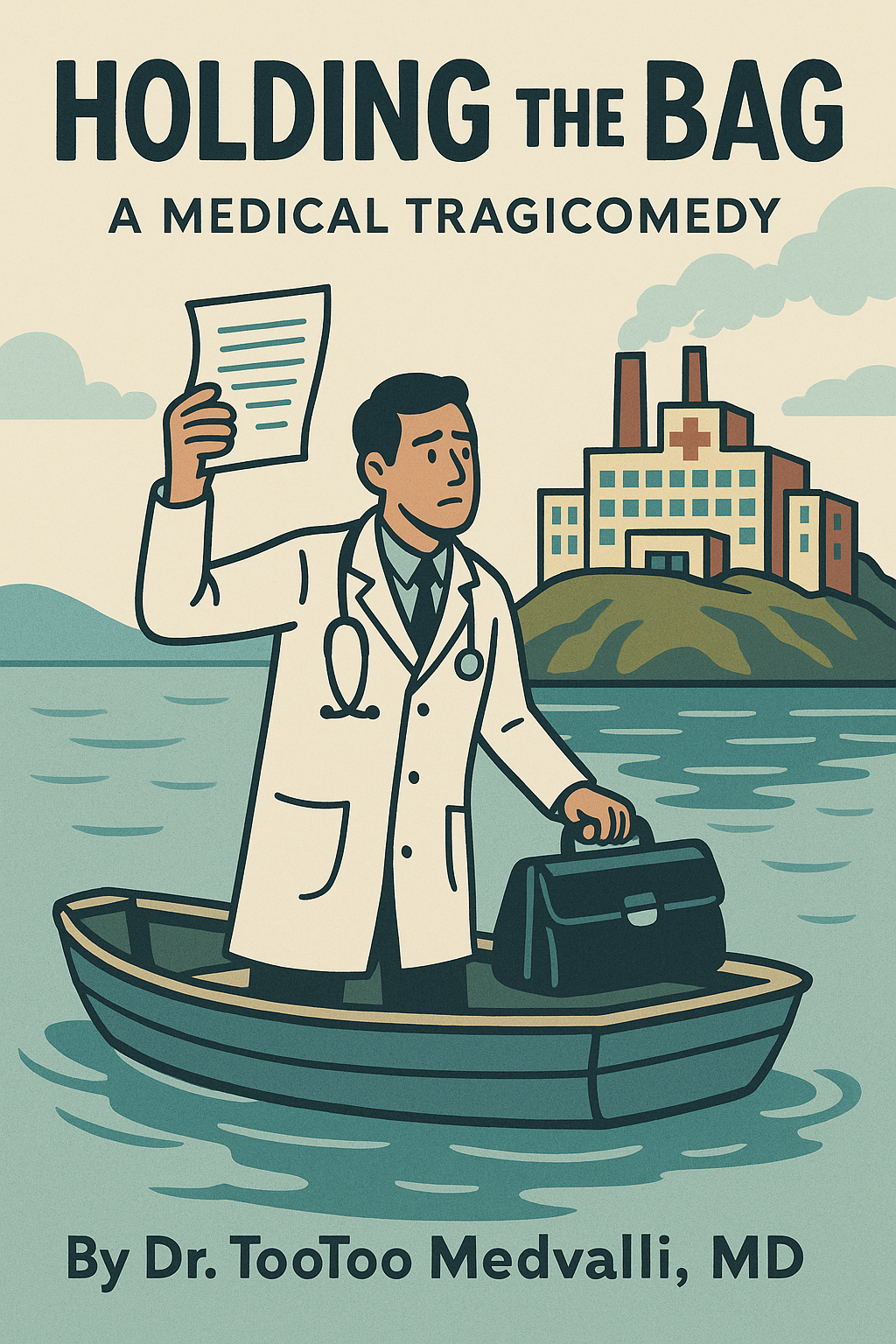

 Minimally invasive software